32 Paths, One Show: The Chaos and Joy of a Student-Created Musical
This Show is a Whole New Adventure
Plays are hard. Musicals are harder. They have so many moving parts. Now add audience voting on the path of every scene, dance breaks, and a team of teenage creators, and you have a real adventure.
If you’ve been following the Backstage AIC Facebook page, you’ve seen my posts on our summer show, The Untimely Adventures of Erastus Calculus. The production is now in tech and just a week away from opening. And tech is a beast.
The Challenge (and Joy) of 32 Possible Paths
With this particular show, the audience choices could lead to 32 possible combinations, with links that vary. It has been a joy in the best way. It’s also been a challenge in the best way. It’s been about getting back to the roots of “What if we could do this?” rather than “We have to do this.” Because we have limited time (quick, cheap, or right; pick two), the project has forced me to step back and say, “How can we find a way to make that happen with simple techniques and the basic theater knowledge this team has.”
I will give all credit to the students who wrote this, they thought about transitions. As we designed the show, we used their thoughtful lay out. Many of the scenes that lead into new sections have the same basic building blocks, so regardless what choice the audience makes, the primary set pieces and configuration can be the same, with variations in props and furniture. I’ve done mainstream modern shows that don’t consider transitions as well.
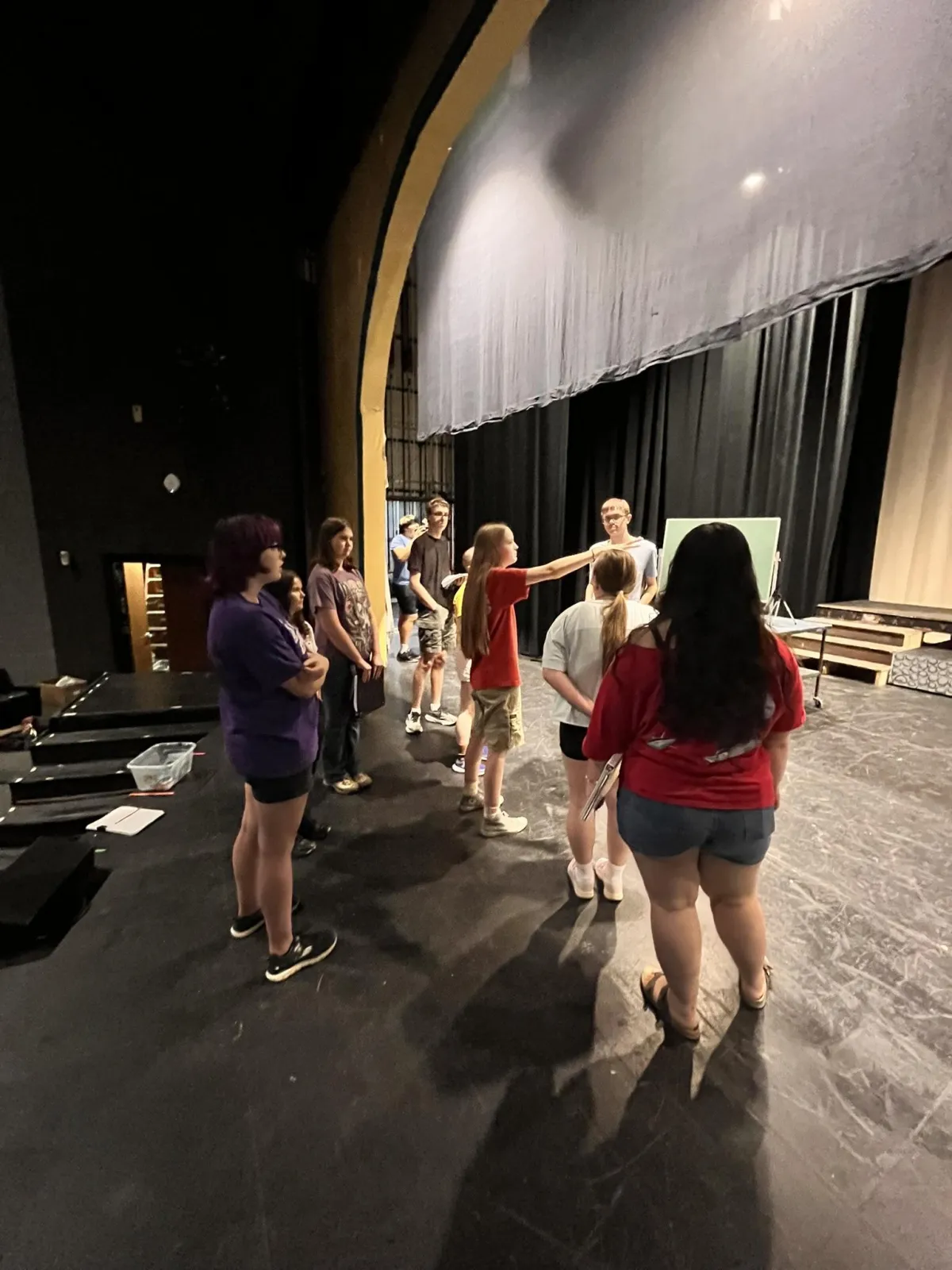
We had an extended tech period for this show because, given the number of variations, we needed to tech getting out of each scene into two possible scenes from that. So every path into and out of the sections on the flow chart had to be rehearsed multiple times because we could go to different scenes or places. We call it the slow crawl, going through and really picking apart what we’re doing, and it took a full week of rehearsals.
As we moved into runs of the show, we added our lighting in. They are really picking up and doing well with the fluctuations. We’ve run it through twice now, two different variations, and there were minor hiccups in both, but no major problems. To avoid train wrecks with this kind of show is a testament to the focus the crew has.
Life Skills in the Working World
Most of our issues with tech have been around attendance, because again, it’s summer. We have students who are in summer school, so they can’t be there the whole day. We have students who are going on family vacations, so they’re missing chunks of rehearsal at a time. The student director, stage manager, and deck chief are figuring out how to do all these shifts while subbing people in, because not rehearsing is not an option
This show has been a confidence builder. We talk about people finding their place in theater, but this show has really proven it is also a huge test of core skills for life in the working world: understanding your place in a team that relies on you to get a hard project through to completion. And the competition is all on the students. They are learning to reach out to others when they need help or when they don’t have the skill set to finish a project and need to bring people in. Then taking the steps to find that person and making the call. That has become harder and harder for students in the past few years. In our high school, we’ve noticed that they see every interaction as a potential conflict, and they are very conflict-averse.
Conflict, Creativity, and Growth
Working with a team in theater, an artistic team, means there’s going to be differences of opinion and conflict. And that has been, I think, an even bigger issue among the core artistic team for this project: How do you deal with those conflicts? I’ve seen everything from, “Oh, we’re just going to suck it up and do it, and we’re going to not discuss it,” (which is not the way to handle it) to tantrums.
I’ve also watched them start articulating why something matters to them. Now, that doesn’t always mean that it can be accommodated in the flow of the show or by the director, but they understand now that articulating why something needs to be a certain way, instead of just saying, “I want it this way and you should just listen to me”, is incredibly important. It moves us not only toward a smoother rehearsal and tech process but a better product overall when the understanding by the whole team is there.
Rediscovering the Joy
Through this process, I am rediscovering what I absolutely love about doing this for a living. I have worked straight through many days on this show without blinking, something that hasn’t been happening for me in the regular school year, when I’m stopping for attendance, disciplinary issues, or when I have to be the classroom manager instead of the educator.
I am truly enjoying this process and working with the kids in this way, which is both more structured, because we’re setting the structure for the good of the show, and less structured, because we don’t have to worry about grades, classroom management, or reporting.
The Bigger Picture
This summer, I’ve been reminded why I fell in love with theater in the first place. It’s not just about the final product, it’s about the process, the people, and the passion. It’s about giving students the space to create, to struggle, to grow, and to learn what it means to be part of something bigger than themselves.
Summer theater hits different, as I’ve written before. There’s a freedom in it, a chance to focus on the art without the weight of the school year’s constraints. But this show, The Untimely Adventures of Erastus Calculus, has taken that to another level. It’s proof that when you trust students with creativity and responsibility, they rise to the occasion in ways that surprise even the most seasoned among us.
Your Turn
What’s a project that reignited your passion for what you do? How do you handle the chaos and creativity of working with young artists? Share your stories in the comments or over on the Backstage AIC Facebook page. And if you’re local, come see the show, it’s a testament to what happens when you let go of the “have to” and embrace the “what if.”