Creating Erastus Calculus: An Adventure of a Musical
We’ve officially begun the production process for The Untimely Adventures of Erastus Calculus, a title that’s as ambitious as the project itself. This isn’t just any student-written musical; it’s a choose-your-own-adventure musical, which means it’s essentially four musicals in one.
Two years ago, a determined young writer set out to tackle what might be the most challenging creative endeavor imaginable: writing a full-length show, making it a musical, and structuring it as a choose-your-own-adventure. The result? A sprawling, interactive experience where the audience’s choices shape the story in real time.
The Team Behind the Vision
Our production team is a blend of past and present: the director is a former student now in college, the assistant director is a current student, and the writer—a current student—graduates this Sunday. The rest of the production team are high school students, all bringing their passion and energy to the table.
But here’s where it gets interesting: what started as the writer’s solo vision has evolved into a family affair. The writer’s siblings co-wrote the project, and now the entire family is funding it. Suddenly, what was once a single artist’s dream has become a family operation. That by itself is wonderful. How many students have families that would dive so deeply into their passion? It has created a huge challenge, though. A committee-driven design process, with everyone wanting their vision represented in the show’s visual design.
The Challenge: Design by Committee
The Reality of Collaboration
Only one person in this group, the writer, has firsthand experience with what it takes to mount a production. Yet everyone has a stake and everyone has opinions. As we began pulling stock pieces from storage, stair units, platforms, bridges, wagons, walls, we realized we were facing a new hurdle: whose vision are we actually designing for?
The writer wants X.
The family wants Y.
The director wants Z.
And I found myself asking: Who am I designing this show with? The director? The writer? The entire family?
The Hard Conversations
We had to sit down and address this head-on. Challenging conversations, as uncomfortable as they can be, are what make art better. My goal was to ensure everyone left feeling heard and valued, especially since they’ve invested two years into this project. But we also had to be realistic:
You can have it quick, you can have it cheap, or you can have it right. Pick two.
In our case, it has to be right (safe for the performers and safe for the facility. Also, possible within the constraints of our stage), and (because we are now 8 weeks out with a volunteer student build crew) it has to be quick. That means it’s not going to be cheap. There has to be give and take.
Finding Common Ground
After our meeting, everyone felt good about where we landed. We agreed on a unified style for the show, rather than each scene looking like a separate production which, while an interesting idea, would have required far more resources than we have.
We also discussed specific set pieces that were important to the team. When they explained why a particular element mattered, how it tied into the story or the visual narrative, it became clear that some ideas were worth the extra effort. For example, one set piece, while adding to the build, was visually essential to a key moment in the story. We found a way to make it work.
But we also had to pull back in other areas. No, we can’t build a whole city in addition to everything else. Instead, we asked: How can we evoke the feeling of a city in a way that’s structural, cohesive, and fits within our constraints?
The Power of a Visual Reference
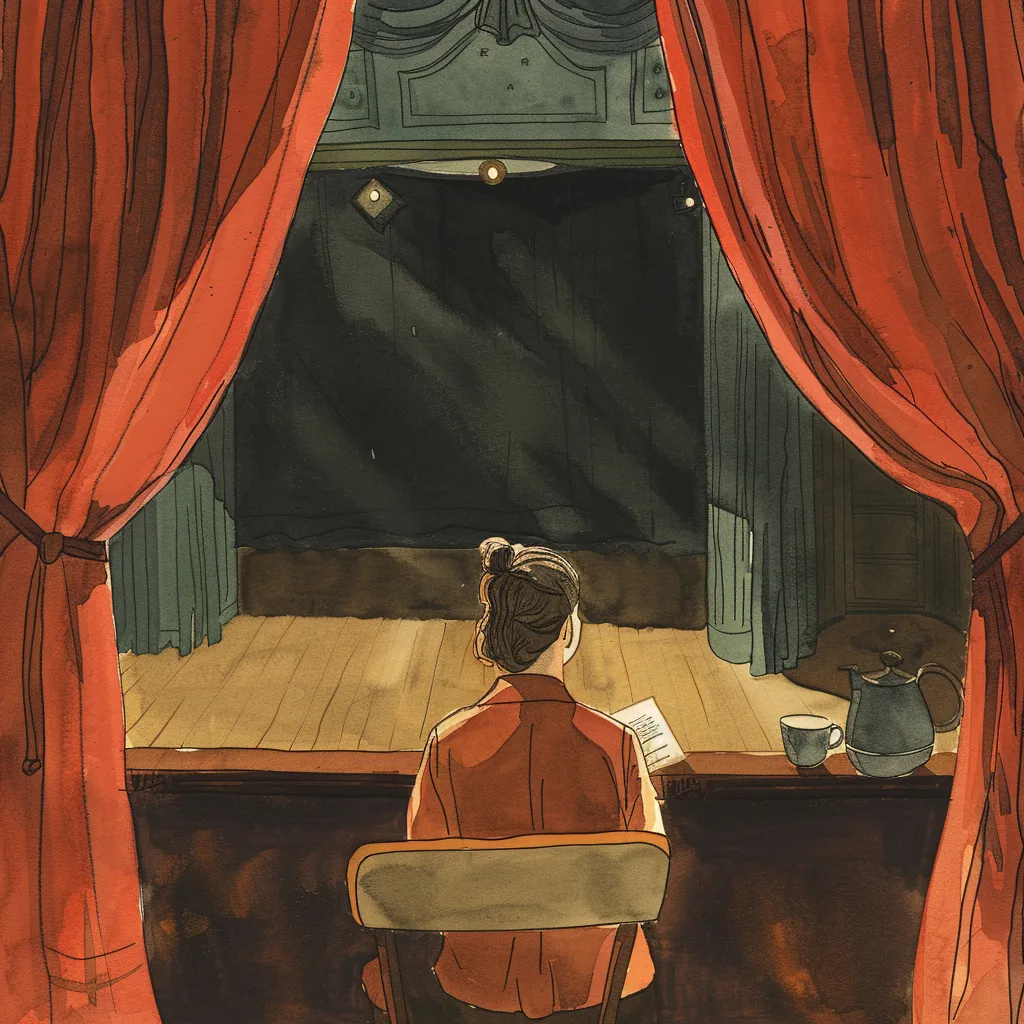
One of the reasons we were able to align so well is that we started with a piece of artwork as our stylistic anchor. When you have eight people with a stake in the project, all of whom have read (or even helped write) the script, everyone will have a different image in their head. Pictures on the page are the great equalizer. They give everyone a shared starting point, a visual language to frame their ideas around.
This is why a clear design process is so important. It turns abstract ideas into something tangible, something everyone can point to and say, Yes, that’s what we’re building toward.
The Solution: Clear Roles and Communication
To move forward, and the lessons the students are taking away from this, is we established a few ground rules:
One Decision-Maker: We needed a single representative from the family to serve as the final decision-maker for artistic vision. Otherwise, we’d need the entire family present at every production meeting, which isn’t practical.
Physical and Practical Limits: Some ideas simply aren’t feasible in our space or for our performers. For example, certain materials aren’t dancer-friendly, and doubling up on set pieces would require more time and resources than we have.
Safety and Artistry: If it’s a safety issue, the tech director (me) has the final say. If it’s about artistic vision, we need to know who’s in charge.
With these ground rules laid out we could communicate effectively without hurt feelings, everyone could advocate for their ideas while respecting others’ input and the whole group could work within deadlines and constraints.
Curious about the production? It has a webpage! Visit The Untimely Adventures of Erastus Calculus and erastusmusical.com.