Hiring Professionals vs. Student-Driven Work: Navigating Options High School Theater
If you're in theater you know, theater is a team sport. And like any team sport, it requires specialists: lighting designers, set designers, projection designers, costume designers, music directors, publicity teams, and front-of-house staff. All of these roles need to be filled. School budgets are tight. School budgets are always tight. In many high school situations, one person, often a teacher with other class responsibilities, ends up doing everything: the one-person show. So how do you make it work when you’re one person with only two hands and a mere 24 hours in a day? There are three paths: collecting volunteers, hiring a team, or letting the students take the spotlight. Each has its benefits and drawbacks.
Community Involvement: The Ideal Scenario
If you’re in a very active community with strong family involvement, you’ve got a built-in team. From an educational standpoint, this is the ideal way to go. The more people you can involve, the more you’re building community, which is what theater is all about.
Volunteer flow often runs in cycles. Make sure that as you build your base, you keep the flow of new people coming in. Ask yourself: what would attract you to be a volunteer?
How to Build Your Dream Team
Get to know your families and community early in the season. Have an informational meeting, we like to wrap ours in a picnic.
Get them excited about what you’re doing and impress upon them how important they are to the process.
Figure out where the strengths are and let people fill in where they feel most effective.
Set clear schedules and lines of communication.
If you don’t get everyone you need right away, keep reaching out. It takes time to build trust. When people see you are building relationships and creating community, not just looking to fill a need, they will be more likely to join up. Consistency is key when building community.
Action Steps to Stay Organized with Volunteers
Keep a contact sheet with job titles, phone numbers, emails, and availability.
Maintain a shared calendar for meetings, build dates, and rehearsals.
Lay out targets for your production on the calendar and make sure you (and your volunteers) know what happens when those goals aren’t met. How does the plan change? This gets ahead of any stress. Having a plan sets everyone at ease.
Remember to say thank you, often.
The Pros and Cons of Hiring Professionals
Sometimes, you don’t have that volunteer base or that dream team. Whether it’s due to location, distance, economic factors, or other challenges, parental support isn’t always available. That’s where hiring professionals can help.
The Benefits
Less stress for the director: You know that portion of the job is going to get done.
Reliability: With strong communication, you can trust that the work will be completed safely and on time.
Students learn from working with pros: Theater is an industry with real jobs, a fact that often escapes parents, administrators, and students. When a professional outside designer can come in and work directly with students, they get the opportunity to learn not only the skills to get the show on its feet but also that theater can be a viable career path after high school.
The Drawbacks
Cost: Hiring a professional designer can run anywhere from a couple thousand to $10,000, especially if they’re also building the set. For a high school production, this can quickly push your budget into the $30,000–$60,000 range. That sounds crazy to some, but when you break it down, that’s not an unreasonable number for a full-length production. If you’re interested in how that looks, send a comment or email, I can send you a breakdown. Sometimes it’s helpful to see how other theaters and schools use their budgets when planning your own.
We make it a point in our program to bring in professionals on every show. Right now, we have a team of alumni designers who are now working in the field and come back to share their knowledge in the place where it started for them. That's a powerful visual for students to see. Not only are we employing professionals (it is important to us that our artists are paid), but these young pros can say with confidence and clarity that they know exactly what our students are going through because they have been right there. It keeps our community strong and connected.
We also bring in at least one new guest artist a year to build on that community. Sometimes that requires a speaker's fee, which we cover with grants and fundraising. Working with new artists is important for everyone involved, student and adult alike. It keeps our ideas fresh and reinforces the positive growth we want from our students.
The Student-Driven Approach: Creativity with Guidance
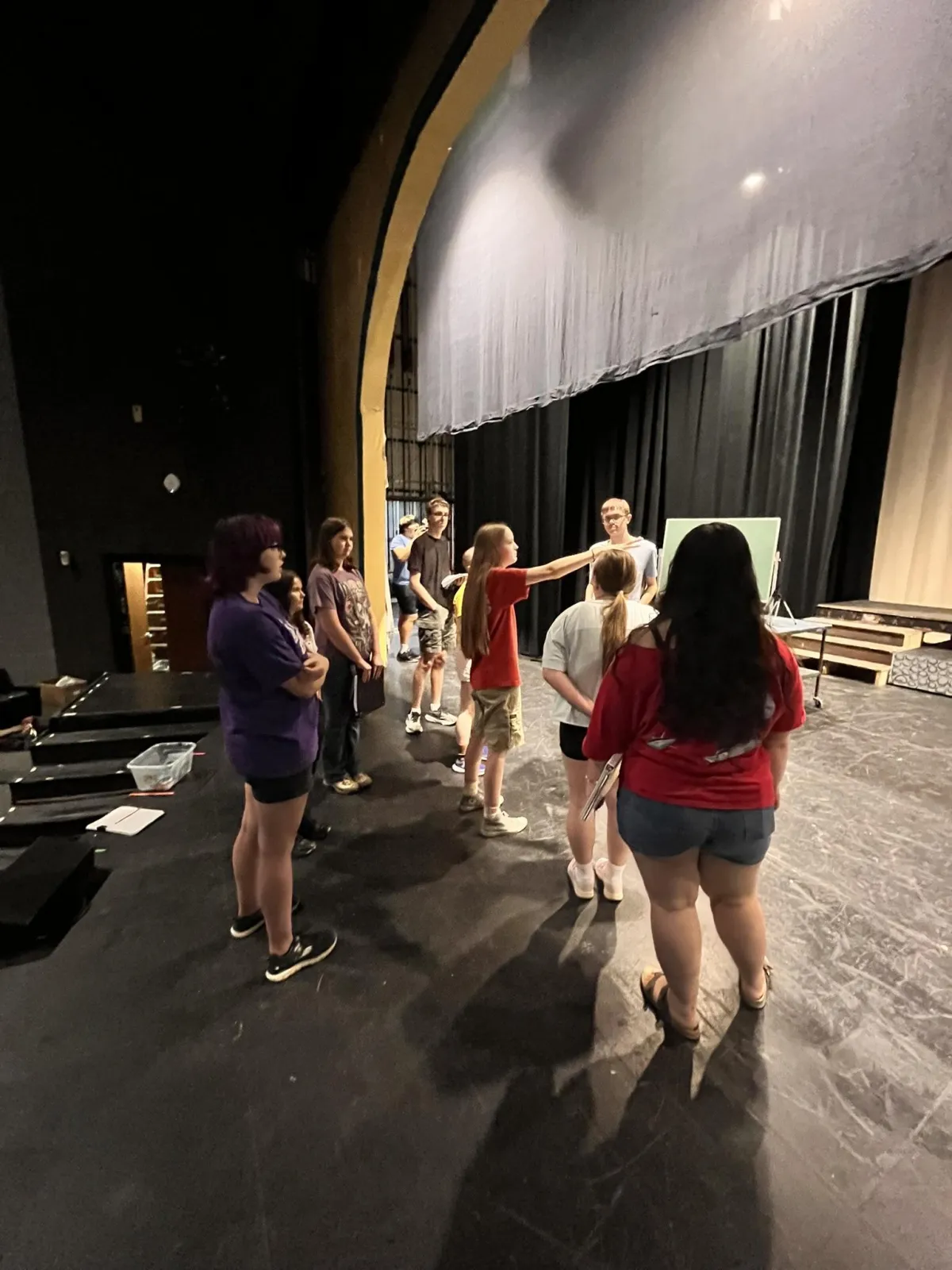
On the student end, the biggest benefit is students taking the lead and creating everything. But what they need is guidance, someone who understands how to do things safely so they’re not making it up as they go. You’re putting people on the set, in front of the set, in costumes, and under the lights. Safety is non-negotiable.
The design process and the build process are two different things:
Design is creating a picture of what you want the set to look like.
Build is creating the plan and taking that image from paper to stage. It’s thinking under the skin of the set, what is creating the structure.
When your students take the lead on the build, pre-check every aspect. Work out details on paper before cutting any lumber or committing any funds. Use SketchUp (a free-for-education modeling program) to plan the builds or create paper models to test ideas and spacing. Student builds will require at least three times as much time as it would for an experienced professional. It will also take more materials because students will make more mistakes. Those mistakes are incredibly important. They’re the best way to learn. Understand where the trade-offs are (time and money) and be clear about the expectations when you start.
Student build productions can be wildly inspirational for an entire school. Success feeds success and when students see their friends creating and accomplishing big things, they want to accomplish big things too. It is important to manage your own expectations in this process. Keep the bar high and the vision in sight, but remember that skill level will vary based on where your kids are in their learning journey. Growth is the goal, and should be celebrated throughout the build, during the run, and even at the post mortem when discussing what to improve the next time around..
Budget-Friendly Alternatives to Hiring Professionals
If hiring isn’t an option and you need a little extra support for your students, here are some ways to ensure you have the expertise you need:
1. Local Colleges with Theater Departments
Reach out to nearby colleges. College students need experience and portfolio opportunities, and they might be willing to help. However:
Check their availability: College theater students are often busy, and some departments don’t allow outside work.
Prioritize shop experience: Make sure the students you bring in have hands-on build experience, not just theoretical design knowledge.
Talk to technical directors: They may be willing to help or send students your way. It’s a win-win, they build their programs, and you get the support you need.
2. Community Theaters
Community theaters often have:
Volunteers with experience
Professional technical directors who understand safety standards
They may be willing to lend a hand or connect you with someone who can.
3. Online Resources
If you’re on your own, there are plenty of resources to help you tackle the technical aspects:
YouTube: There’s a lot of content out there, some good, some not. Vet your sources carefully.
Educational Theater Association (EdTA): Their website, schooltheater.org, has tons of educational materials.
USITT: Their student wing is a great resource, and they offer a safety exam.
National Federation of High Schools: They have a safety starter program with useful information for new directors.
4. Rigging and Safety
If your production involves fly lines or rigging, hire a professional. You should not be hanging anything heavier than picture frames unless you know how to do it safely. There are weight limits and standards to consider before hanging scenery over someone’s head. Look for theatrical rigging specialists in your area. Many offer in person classes for educators that will help you understand your system so you can safely handle the basics on your own. They can also help you figure out what works within your space and your budget. They want to see your project succeed safely.
Backstage AIC Resources
For step-by-step instructions on building the basics, visit the Backstage AIC website. You’ll find guides for:
Flats
Platforms
Staircases
Rehearsal cubes
These are the foundational elements for any theater program. Building a good stock inventory allows you to reconfigure sets for years. Think of it like scenery with Legos, you’re giving students the building blocks for creativity.
There are different ways to build flats and platforms- stress-skin platforms, 2x4 frame platforms, triscuits-all valid depending on how they’re being used. The instructions on Backstage AIC are based on the methods I’ve used for 25 years. They’re step-by-step with diagrams, tool lists, and cut lists to make it as seamless as possible for teachers. The site also includes:
A basic set interior that can be configured for multiple shows.
A two-story set that works for several productions.
Plans for escape stairs and short staircase units
These sets are modifiable for any number of productions. Your students can do this, my freshmen do it every year. Once they gain confidence, you can focus on the aesthetic and creative aspects without worrying about the structure.
The Bottom Line
Theater is a team sport. Whether you’re hiring professionals, leaning on community volunteers, or guiding students through the process yourself, the goal is the same: to create something safe, meaningful, and inspiring. Budget constraints don’t have to limit creativity, they just require planning, resourcefulness, and community. And remember, the most important thing you’re building isn’t the set, it’s the skills, confidence, and passion of your students.
Your Turn
How do you handle the design and build process in your theater program? Do you hire professionals, rely on volunteers, or guide students through it all? Share your experiences and tips in the comments or over on the Backstage AIC Facebook page. Let’s learn from each other!