How to Turn a Theater Project into a Cross-Curricular Powerhouse
Theater isn’t just an art, it’s a classroom without walls. When students work on a production, they’re not just acting or building sets; they’re applying math, physics, business, history, and more in ways that textbooks can’t match. With student driven theater, production becomes a living lab for core subjects, real-world skills, and collaboration across disciplines.
In this guide, I’ll walk you through how to design a theater project that seamlessly integrates multiple subjects, engages students in hands-on learning, and even fosters partnerships with other classes or departments. Whether you’re a drama teacher, a STEM educator, or an administrator looking to maximize the impact of your programs, this is your playbook.
Step 1: Start with a Student-Led Project
The foundation of cross-curricular theater is student ownership. When students drive the creative process, they invest more deeply in the learning.
How to Do It:
Choose a Project: Start small; a one-act play, a series of scenes. We were fortunate this past school year to be invited to participate in Wisconsin’s state-wide Celebration of the Arts. Students wrote and produced a 15-minute scene based on a poem chosen by DPI. Their entry is combined with music, art, and poetry from other schools and is now available on the WI DPI website. You could even do a musical like we did with Erastus Calculus. That was completely student-driven and took several years. However you start, the key is that students are involved in the creation, not just the performance.
Define Roles: Assign or let students choose roles that align with their interests and skills. For example:
Identify your storytellers. Don’t let the label “writer” scare them. There are lots of ways to get thoughts onto a page. Focus on the idea of scriptwriting to begin with, not the mechanics. (English, creative writing).
Find your musically inclined, or even your music enthusiasts. They might be stealthy. They don’t need to write music to start. They can find songs that are inspirations or support the story. Put together a soundtrack that supports the ideas. If they want to take it to the next level and actually create original music, this becomes the opportunity to cross over and create the opportunity to work with people who can write music or find the tools to help them turn their earworms into music they can share (math-yes, really-, music theory).
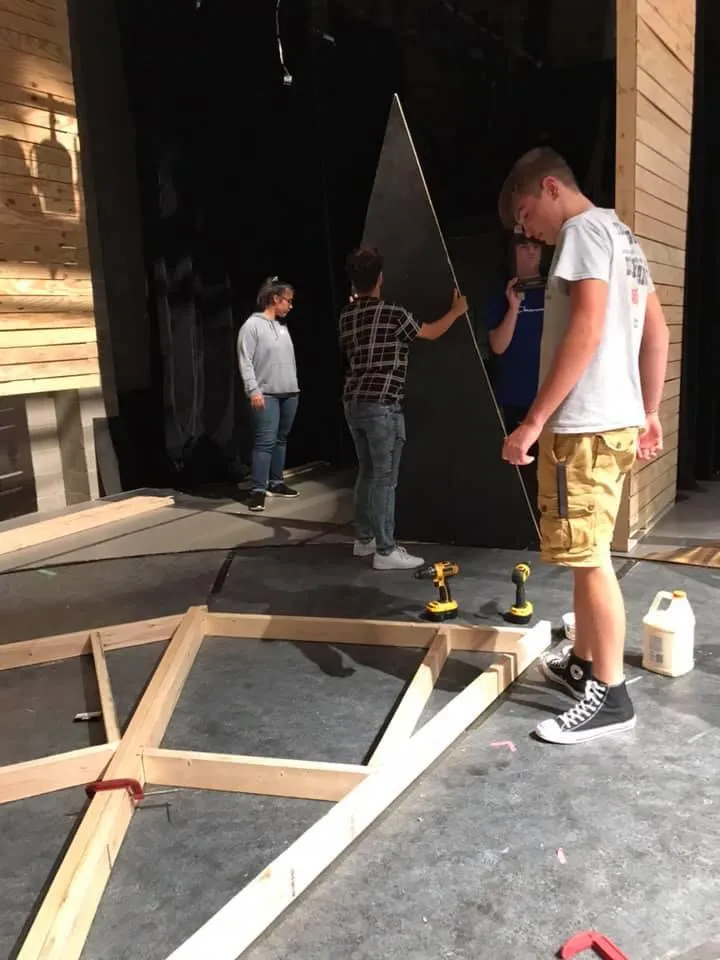
Do you have students who clearly see those described spaces? Kids who love to create visually? Theater needs designers. Draft them to work on sets, lights, projections, or costumes (art, physics, engineering).
Putting it all together from the top down requires an organized and forward-minded team. These are your business managers, your company crew. Because someone has to handle budgets, contracts, and marketing (math, business, communication).
Step 2: Identify Cross-Curricular Connections
Once your project is defined, map out how it can tie into other subjects. Theater is uniquely positioned to incorporate almost any discipline, you just need to get creative.
Subject Breakdown:
Subject Theater Task How It Applies
English Scriptwriting, dialogue Grammar, narrative structure, character development.
Math Music composition, budgeting, Rhythm as fractions, budget calculations, geometry construction, design in set design.
Physics Lighting, rigging, Understanding photometrics and color theory, special effects structural integrity, forces, and motion.
Chemistry Paint, special effects Mixing paints (additive color theory + chemical reactions), fog machines, or pyrotechnics (safely!).
Business Contracts, marketing, Negotiation, budgeting, social media campaigns, house management ticket sales.
History Research for period pieces Contextualizing the time period, costumes, and societal norms.
Psychology Character analysis, directing Understanding motivations, emotions, and relationships.
Tech Ed Set construction, automation Welding, engineering, or programming for stage effects.
Partner with teachers from other departments. For example, work with the tech ed departments for steel framing or automation effects. We've worked with out CTE department for precision cutting, fabrication, and build assistance. Industrial design and fiber arts will bring new insights to your design process, and if you have marketing class, turn them loose on your promotional materials!
Step 3: Assign Real-World Tasks
The magic of theater is that it mirrors the real world. Students aren’t just learning theory; they’re applying it in practical, high-stakes situations. The audience will be in the seats whether the show is ready…or not. Deadlines are real.
Start with your opening night and work backward to create your deadlines, just as you do for your actors. Keep the calendar visible for students and mark deadlines and checkpoints clearly. Celebrate the deadlines met and discuss the ones that are missed. These lessons are perhaps more important than the ones they hit. How they deal with a blown deadline is too often a lesson not taught. How will you, as a team, get caught up? Identify, but don’t vilify, how you got behind. Can it be avoided on the next milestone? Remember, the project doesn’t end because the deadline was missed. The audience will still be there, so what will they see when the curtain opens?
Task Ideas by Subject:
Math: Calculate the cost of materials for sets or the geometry of stage angles. How much weight goes on that arbor if we have a single purchase system? A double purchase system?
Physics: Design a rigging plan that safely supports the set. What are you flying, and what equipment do you need to do that? What is the load limit of the platforms the designer wants to elevate? How does that get calculated?
Business: Create a marketing plan for the show, including social media posts and ticket sales strategies. How can they reach out to local businesses for support? What kind of reciprocal relationships can be built in the community to ensure interest and support beyond just one show?
English: Write program notes or a concept statement. What styles of writing are needed for the communications required around the production, not just the script itself?
Industrial or Textile Arts: Design costumes or sets that reflect the show’s theme or historical period.
CTE: Build a better wagon, or better yet, that turntable you always wanted.
Example: For Erastus Calculus, students had to negotiate contracts with musicians, artistic team members, and directors. This taught them real-world skills in communication, budgeting, and problem-solving, practical lessons they’d never get from a textbook alone.
Step 4: Align with Standards
To make this work in a school setting, tie each task to academic standards. This not only justifies the project to administrators but also ensures students are meeting learning goals.
How to Align:
Research Standards: Look at your state or national standards for each subject. For example:
Math: "Apply geometric concepts to real-world situations."
English: "Write narratives to develop real or imagined experiences."
Science: "Design and conduct investigations to solve problems."
Document Connections: Create a simple chart or checklist showing how each theater task meets a standard. This is gold for grant applications or admin buy-in.
Our district uses the National Standards for Theater, which can be found here.
Example: Lighting design can align with physics standards (e.g., "Understand the properties of light") and art standards (e.g., "Use color and light to create mood").
Step 5: Assess and Reflect
Assessment doesn’t have to mean tests. In theater, the product is the proof, but you can also incorporate reflections, portfolios, or presentations to gauge learning.
Assessment Ideas:
Portfolios: Have students compile their work (scripts, designs, budgets) with reflections on what they learned. Portfolios are real world tools designers use in job interviews. The medium has gone digital, but the purpose remains the same.
Presentations: Ask students to present their process (e.g., "How we designed the set" or "Our marketing strategy").
Peer Feedback: Use rehearsals or tech weeks as opportunities for students to give and receive constructive criticism. Notes are a perfect example of feedback already built into the theater framework.
Self-Evaluation: Have students write about their growth (e.g., "What was challenging? What would you do differently next time?"). Again, a natural part of the theater process that would benefit students across the academic spectrum.
Example: After our shows, we debriefed as a group, a post-mortem. Students shared how they overcame challenges, like finding a new welder after a contract fell through, and how those experiences built their confidence and problem-solving skills.
Step 6: Scale It Down for the Classroom
Not every project needs to be a full-scale production. You can apply these principles to smaller, classroom-friendly projects to make cross-curricular theater accessible year-round.
Small-Scale Ideas:
One-Act Plays: Focus on a single subject (e.g., a history-based play for a social studies class). A few years ago, social studies students were invited to compete in a national competition to write a poem or a song about American history, focusing on the founding documents. Winners got to meet Lin-Manuel Miranda and see a production of the national tour of Hamilton.
Scene Work: Assign students to write and perform scenes that incorporate topics they find hard to understand. See what insights they can gain by changing the approach.
Design Challenges: Have students design a set or costume for a hypothetical production, using constraints (e.g., budget, materials). How does limiting the budget (or adding other constraints) change the approach to the project?
Improv Games: Use improv to teach quick thinking, collaboration, and even language arts (e.g., "Create a scene using 5 vocabulary words"). And improv isn’t just for your performers. How can you use quick thinking games to improve your tech students’ skills? Five minute design? Tell this story with only three essential items?
Conclusion: Theater as the Ultimate Classroom
Theater doesn’t just teach core subjects, it brings them to life. Students don’t just learn about physics; they use physics to light a stage. They don’t just study business; they run a business to put on a show. And in the process, they gain confidence, collaboration skills, and a deep understanding that big ideas are achievable.
Our experience with Erastus Calculus showed that when students are given the space to create, they rise to the occasion. They write musicals, negotiate contracts, solve engineering problems, and, most importantly, they learn that they’re capable of more than they ever imagined. And the people in their orbit see it, too. Parents, siblings, and peers. The inspiration ripples out, and the next goal becomes a possibility instead of a pipe dream.
So, whether you’re a theater teacher or a math instructor, I challenge you: Find one way to bring theater into your classroom this year. Start small, think big, and watch your students shine.
Call to Action
Have you used theater to teach a non-arts subject? Share your stories in the comments! Or, if you’re new to this idea, pick one task from this guide and try it with your students. Let us know how it goes in the Backstage AIC Facebook Group , we’d love to hear from you.
Want a downloadable checklist for planning your cross-curricular theater project? Download it here