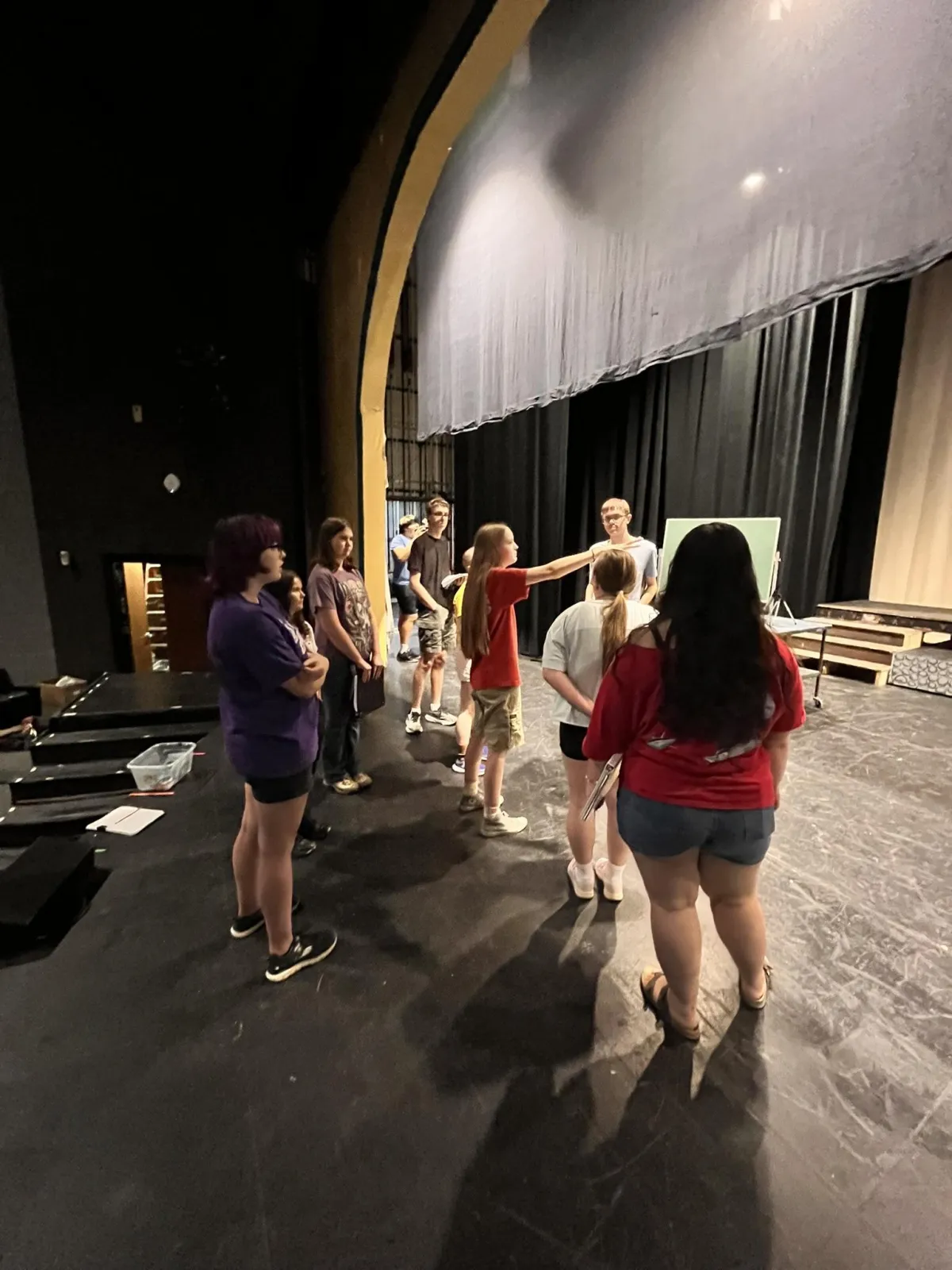
Let Them Make the Mistakes: Stepping Back So Students Own the Stage
I spent this week bouncing between two very different theater programs, working on two shows at once; one at my home base, one at a school I've been lucky enough to work with for three years now. And somewhere between the two buildings, I found myself thinking about the hardest part of my job. It isn't the schedule, the budget, or the scenery that has to go up a flight of basement stairs. It's stepping back.
Here's the thing about being hired by a school to design a show: designing the show is the job. Building it perfectly? Unless I am also hired to build that show, the construction belongs to the students.
Many people assume that those are the same thing, because at the high school level, it is often treated as the same job. But if I'm hired to teach a class, I'm responsible for the results of that class (the skills the students are learning, the mechanics of standards and benchmarks) not necessarily the results of the production connected to it. Those sound like the same thing. They are not. And confusing them is how a tech director (or well meaning teacher) ends up doing the students' work at eleven o'clock at night.
I'll be honest about my weakness here. I'm a scenic artist at heart. If I could back up and start over, I'd probably be a scenic artist full time and not a designer or a tech generalist. There is nothing I love more than losing myself in a rendering, a brush in my hand and a blank drop in front of me. So when a paint job is going sideways, every fiber of me wants to stay and fix it. To make it right.
But unless I'm willing to sit there and do the work myself, and I'm not, because that's not teaching, my job is to teach them and let them practice. And letting them practice means letting them make mistakes.
Not all mistakes are created equal, though, and it's worth sorting them out:
Skill mistakes. The wrong cut. The measurement that was read upside down (or this week, the DMX address that was read upside down, a 082 that was actually 280. LDs and MEs in the group, you know what I mean. They chased that for two hours before I finally pointed it out) . The piece that isn't quite square. These are not failures, they are the learning process happening in real time. When mistakes become an expected part of the process, people stop being afraid of them. And people who aren't afraid of mistakes actually learn from them. They step back, look at the result, and say, "Okay, what do we need to change here?". That moment, the one where they see it and internalize it themselves? You cannot teach it any other way. You can only make room for it.
Choice mistakes. The mistakes that make me crazy. The wandering off, the playing around, the wasted class period because avoiding work seemed like the better option. These are equally important to making good humans, and they come hand in hand with the skill mistakes sometimes, but they're a different problem. A problem I'd be having no matter what subject I taught. That's just part of being a teenager. It's a behavior conversation, not a tech conversation.
What stepping back does not mean is lowering the bar. The work still has to be safe. We still do things professionally, in the way that teaches them the best results. But the path to the finish line won't look like the path I would have taken, because we've had to make modifications along the way. They're not as fast. They're not as square. The show is not going to look exactly like the design as rendered, and if I want a fully student-run production, that's something I have to be genuinely okay with, not just tolerate with gritted teeth.
So this weekend, at my bonus school, we load in their set. A big curved front edge and a back wall, a lot of paint, a lot of students with brushes. At my home school this week, we finish all the structural pieces we needed for tech, and my goal for both is simple: it's not going to be perfect. That's the point. It's going to look like they did the work, and they're going to be proud of it because they own it.
As tempting as it is to step in and save them, to make it look better, to do it faster, to fix it while they're not looking, unless it's a safety issue, I'm not doing it. If I do, I'm not teaching. I'm telling them they aren’t up to the challenge.
Let them make the mistakes. Then let them fix them. Let them feel what success looks like. That’s the work. That's the show.
What’s the work for you? Share your thoughts at Backstage AIC’s Facebook page.