Backstage with freshmen: A Green Crew Story
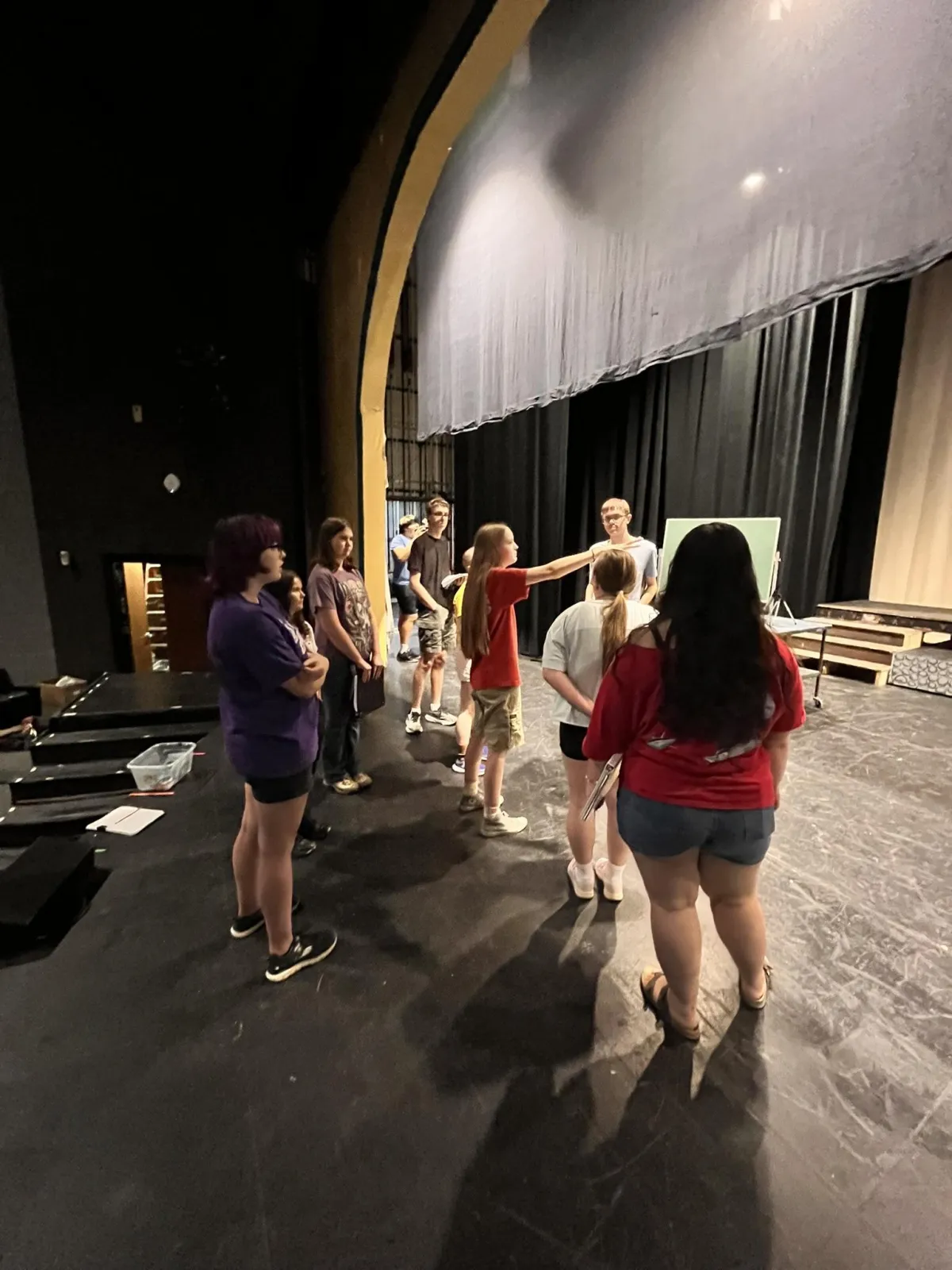
I've written before about how green my crew is this year. That’s normal for a high school, and the first show of the season, but this year is a little extra. On the ten person crew, only two have ever done theater before. We're rebuilding from the ground up, and every rehearsal is as much about team building and leadership building as it is about scenery. That means the season is full of moments where I have to decide: do I step in, or do I step back?
Tonight was a step-back night. And it was one of the best examples of education in action we've had.
The setup
Way back when we were building the crew, I had a scheduling problem we turned into a plan. I have two young ladies who share a deck position, they were doubled up on purpose. They both really wanted to do the show, but each had conflicts on different weekends. Our solution: they'd essentially function as one person. One of them runs the position one weekend, the other takes the next, with a little overlap so the handoff is seamless. If one is absent, the show doesn't feel it. Built-in redundancy. Textbook contingency planning, the kind I want every crew member to start thinking in.
But a plan is only as good as the discipline behind it. If they don’t stick to the plan by making sure they don’t drift onto other assignments backstage, when one of them is gone, the plan doesn’t work. Here's the moment that tests this crew every performance: we have two large opposing set pieces that have to open and close like a pair of giant doors at the same time. Both doors move together, a synchronized shift, and a big one that repeats multiple times in the final scene of the show. For the "you act as one person on deck" plan to work, both of these two needed to be on the same piece. That way, that side of the shift is always covered no matter which of them is in the building, one runs it, one assists, and the doubled position does exactly what it was built to do.
Instead, somewhere in their planning, they got a little soft and split themselves: one on the first door, one on the other. It looks efficiency. “I’m just standing here, so I’ll be helpful and move this other piece”. It feels balanced. And it quietly destroys the plan because at that pivotal moment, each of them became essential, with nobody left over to float, to assist, to be the spare piece.
Which means the exact scenario the doubled position was built to fix would now be the problem. When one of them is absent, her door doesn't open. And that scenario didn’t actually land for them until yesterday’s rehearsal, the day before one of them is stepping out for the next two performances.
The mistake was the lesson
Here's the thing about that planning softness: I saw it earlier in the dress rehearsals. I could have stepped in and fixed it for them. Had they, at any point when I reminded them they can’t be on different set pieces, really examined their shift sheet they would have seen their mistake and moved on. I could have wanted up on stage, physically moved one of them off the unit myself and assigned a different person. That's the efficient choice. It's also the choice that teaches nothing.
Because what addressing the mistake themselves actually did was better. I told them what they needed to account for; the absence, the pivotal moment, the pieces nobody else was touching, and then I stayed out of it. They sat down together as a crew. They worked out who needed to cover what. They ran tonight's rehearsal that way, in the new configuration, and in the process they found their own soft spots, the places where coverage got thin, and they made a modified shift sheet of what they need to shore up before the weekend.
Nobody handed them a solution. They built one. And because they rehearsed it, it isn't a hopeful guess, it's a plan that's already been tested on deck. I did not rescue their error. That went from “Jodi will tell us what to do” to “We can solve this so we don’t look bad and the shift happens on time”.
Not "on the fly"
I want to be careful with how I describe this, because it would be easy to frame it as improvising, kids solving a problem on the fly. It wasn't. That's the whole point.
The reason this worked is that it happened during the rehearsal process, which is the one place in theater where making a mistake is cheap. A missed cue in rehearsal is a note. A missed cue in front of a paying audience is a disaster. When your crew is green, the rehearsal process isn't just for learning the show, it's the sandbox where they're allowed to plan badly, discover how that feels and how it affects the show, and fix it themselves while the cost is still low.
These two discovered that a contingency plan you don't protect is just a piece of paper. That lesson means more when you learn it from your own shift chart than when a director hands it to you.
What I actually did
I want to be honest about my role in that process, because it was small and that was deliberate. My job was three things:
Name the constraints. I told them what had to happen: every piece covered, the pivotal moment safe, the absence accounted for. I did not tell them how.
Stay off the deck. The solution was theirs. If I'd stood over them, they'd have solved my version of the problem instead of theirs.
Let them rehearse the answer. A decision isn't a plan until it's been run. Tonight's rehearsal was the proof.
When you have a good crew, and I'm watching this crew become a good crew in real time, the most valuable thing you can give them is a real problem, real constraints, and room to own the outcome. Especially in rehearsal, where the stakes are practice.
The leadership under the lesson
Strip away the scenery and here's what these two actually practiced tonight, the same skills any leader in any field is still learning:
Planning for absence before absence creates panic. Never planning for absences in a production is a luxury we don’t have. Contingency plans are important. It’s why we have swings and understudies.
Interchangeability is a discipline. Being "the same person on deck" only works if you defend it. Every time you make yourself absolutely irreplaceable at a key moment, you've quietly broken the plan.
Solving beats assigning. The coverage they built themselves, they'll remember. The coverage someone hands them, they won't.
Find your own soft spots. They didn't just cover the hole; they identified where the next hole would appear. That's contingency thinking and it's the muscle I most want this crew building.
This crew is green, but green just means growth is visible. Tonight I watched two students take a plan that failed, diagnose why it failed, and rebuild it without me. That's not something I could have taught from a script.
Give them the constraints. Then get out of the way. That's the job.
How are your new crews doing this season? Share your experiences in the Backstage AIC Facebook Group