Lumber Choices for Lightweight Builds on Stage
Last night, we had our first parent meeting of the season. We get everyone together, talk about the rehearsal process, how important our families are to that process, and we ask for volunteers, usually for front of house and publicity. This year, I also mentioned that I would be building after school and if anyone wanted to join me, I would be happy to have the help.
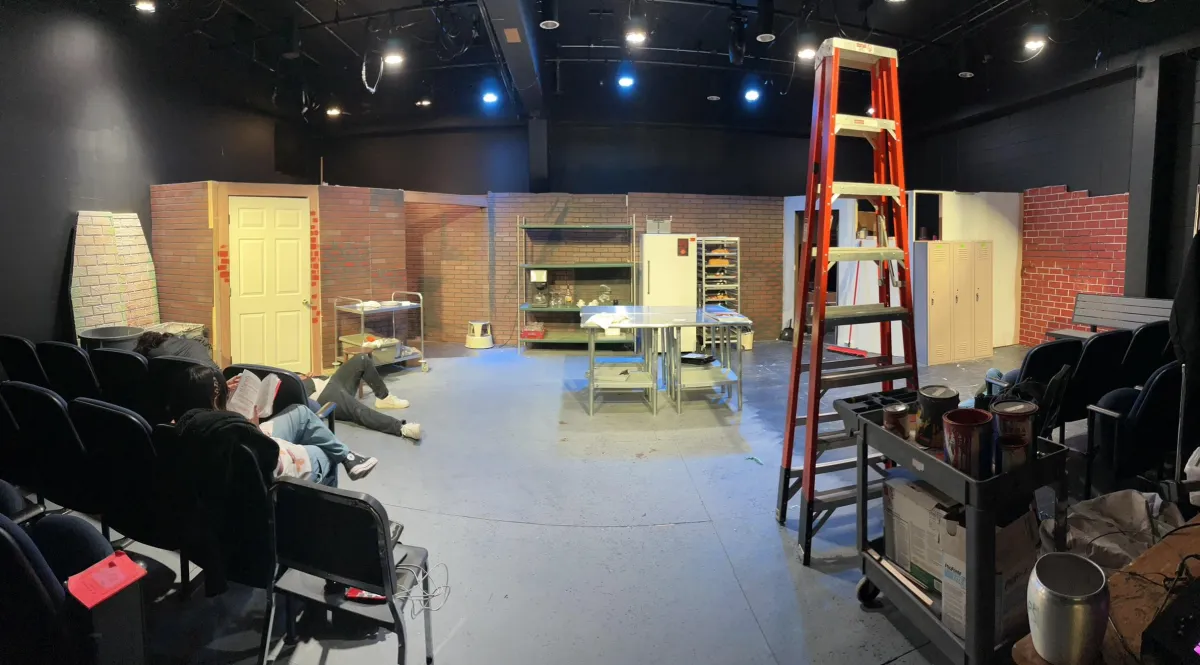
After the meeting, I was approached by a parent who is a mechanical engineer and has built sets for the theaters his child has been in through elementary and middle school. I was delighted! I invited him up on stage to look at what we had started and showed him our shop. What resulted was a very interesting conversation about building for the stage versus building for permanent structures.
"I wish I could get the folks at the other theater to understand they aren’t building a house," he said.
This was the exact conversation I had with my Stagecraft 1 students earlier in the day as we did the lumber identification project. I want my kids to put their hands on the types of lumber we use most in our builds so they can find them without needing me every time. I cut a bunch of scrap into small pieces and fill a bin. After I give them a visual demonstration of linear lumber versus sheet goods, structural versus veneer, I set the bin in front of them, ask them to find a sample of each type of lumber we discussed, glue it to a backer board, and label it. The neatest few we keep in the shop as reference.
Types of Lumber and Their Uses
Here are the types of lumber we use most often in our shop and what we use them for:
Linear Lumber
2x4 Standard Pine
Not actually 2" x 4". This is what the interior walls of your house are made from. It holds up your roof. We make platforms from 2x4s. If an actor has to stand on it, if it supports a second level, this is what we use.
1x4 Standard Pine
Not actually 1" x 4". Same width as a 2x4, half the thickness, thus half the weight. This is what we use for walls. If the wall just has to stand up and look pretty, we can frame it with 1x4. You can even frame it with 1x3, but I didn’t get into that with my new students.
Sheet Goods
¾" Plywood (CDX)
It’s heavy and now rather expensive, but I will take ¾" ply for my platform tops over OSB any day. Five alternating layers of laminated real wood, it is durable, dependable, and holds weight. If an actor has to stand on it, this is what we will cap the platform with.
¼" Plywood
Three layers rather than five, thin but still strong when we need vertical surfaces that require more rigidity. Mostly I use ¼" ply for flat construction, but every now and then I use it to cover flats if that’s what works best for the design.
Veneers
Lauan (Handipanel)
I believe this is called Handipanel in most stores now. It can be mistaken for ¼" ply if you don’t necessarily know what you’re looking at. It can also be had in ⅛" panels, but that is super flimsy. Used for covering flats and facades, Lauan comes pre-sanded and gives a very nice, smooth finish for painting. It will drink paint, so prime it first.
Masonite/Hardboard
Masonite is a brand name, and the brand doesn’t exist anymore, but you can order it as hardboard. I prefer ¼" to ⅛". This is a sheet of sawdust and glue that is so densely compressed we use it as a tap surface. It is way heavier than it looks. It can be easily snapped if bent too far, but it does have great flexibility, so we also use it for the outside edge of our turntable. It needs to be primed on both sides before using it as a floor covering to avoid bubbling or warping. If you can get it double-sided (smooth finish on both sides), you can use it twice as long.
These are the six types of lumber we use most in the shop and some of the applications where we apply them. Walls don’t need to be framed like your house and covered in drywall. Floors don’t need to be 2x8 (in most cases). And while everything needs to be safe, it doesn’t need to be heavy or overly expensive.
If you are looking for plans for basic stage structures, complete with instructions and step-by-step drawings, please visit the Backstage AIC website for build packages.
If you’d like to see more lesson plans or talk about how to get your show on stage, send me an email at [email protected] or find me in the Backstage AIC Facebook group. I’d love to help bring your show to life!