Navigating the Chaos: Teaching Stagecraft to 30+ Students
Navigating the Chaos: Teaching Stagecraft to 30+ Students
The Challenge: Big Classes, Small Spaces
We're four weeks into the school year. Safety lessons are wrapped up, the kids are finishing those final certifications, and I've come face to face with my biggest challenge of the year: the size of my classes.
I have never had stagecraft classes this large. I know plenty of schools deal with even bigger numbers, I have cohorts and compatriots who've struggled with this for years, but I never thought it would be something I'd have to deal with. Yet here we are. My largest class is 32 students. That's 30+ kids, daily, in every section of Stagecraft 1. Over 100 students through the shop in a five hour window.
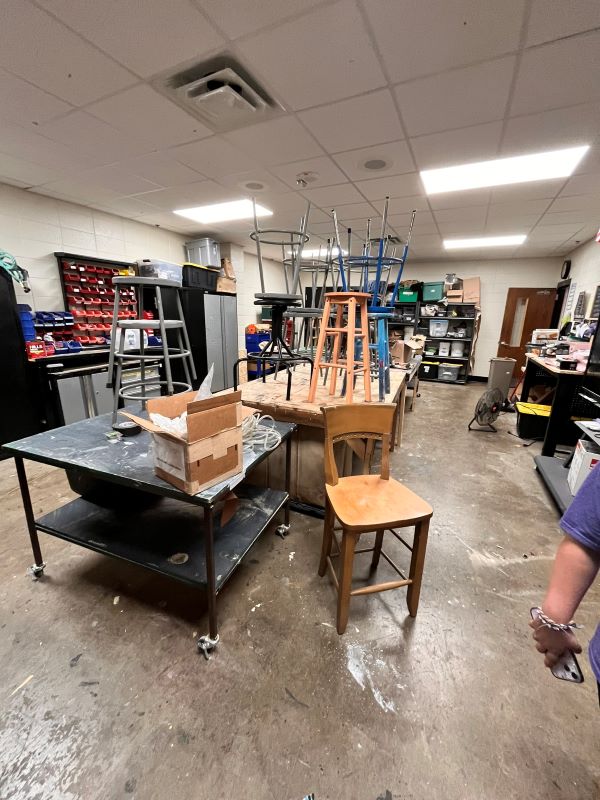
The reality: neither my shop nor my classroom is set up for that. I don't have enough seats and tables for everybody. I don't have enough tape measures let alone power tools to go around. And my shop is one-fourth the size of my stage. In a beautiful, perfect world, my shop would be four times the size of my stage instead of a quarter.
But honestly? I love my shop. It's a great space. It's not echoey, which is a gift. It's just that when you're accommodating people working with power tools and sets laid out at the same time, we can fit maybe two flats laid out at once. So we also work on stage, which means I'm managing multiple spaces. I've done that for years, but never with 30 kids.
The Daily Reality
Let me paint the picture of a 55-minute class period:
10 minutes to get started: attendance, announcements, assigning the work.
35 minutes of actual work time.
10 minute Cleanup. Let me tell you, 30 people cleaning up at once is almost as destructive as 30 people working at once.
Two people on the saw at a time. The panel saw is a three-person operation; the chop saw is a two-person operation. More than that near a saw gets dangerous.
No more than three people on the weight loft at a time and that's not an everyday job anyway.
Three to four people in the catwalk is the max, not because the catwalk is unsafe, but because it gets crowded.
We have one sink in the corner of the room. If multiple people need it, there's a line.
Even at a normal voice level, when you get 30 people talking in the same space, it's a lot. Even in a space with good acoustics.
What I've Tried So Far
Splitting the Group
This week I've been splitting the class: half doing an in-the-classroom lesson, half on stage or in the shop working on projects. The challenge is; none of them know exactly what they're doing yet. If a lesson needs 15 or 20 minutes of my explanation, the other half of the class is stuck waiting for me because they don't know enough yet to move forward on their own.
That will improve as the year goes on. The self-starters, the kids who grasp instruction without a lot of repetition, will move faster, and I can shift them onto larger projects while I hang back with the kids who need more assistance.
Pre-Build Paper and Cardboard Projects
Here's an approach I'm leaning into: handing them instructions and having them do paper and cardboard versions of the real builds before we ever touch wood. Usually, we do small size flats and platforms with scrap wood. This year, i will be pulling out those covid lesson plans for building cardboard and paper platforms and flats. It teaches them the structure of the layout, how to lay out a flat, how to measure, how to make the cuts correctly at scale first.
The beauty is that this takes a couple of days for half the group to accomplish, so I'm not bouncing back and forth every five minutes. A shorter lesson would require far more of my attention on loop.
Videos? Maybe, But There's a Catch
I've considered video lessons, but we're actively trying to get kids off their technology. They're supposed to be off their Chromebooks in class unless it's for a specific assignment. And I know exactly how "I'm watching this video" goes: there's a video game tab open, or they're watching football highlights.
We just went through our safety certification, the National Federation of High Schools course, an 80-minute video with a quiz, and it was me constantly walking around the room, redirecting kids off their tabs. Look, I get it. I have 200 tabs open on my own computer. But for getting real work done, it's less than optimal.
Groups of Three
We do work in groups, and I've learned the hard way: three is the perfect number. Four is acceptable. Once you get past four people, somebody is always not working. So we assign roles; someone in charge of the instructions, someone getting the tools, someone getting the materials, someone handling the layout.
With 30 kids, that's eight groups. Eight! Even split into groups, I've got six minutes per group, if that, once you factor in writing passes, assigning and cleanup.
The Benefits of a Big Class
Here's why I feel like it's so important to get this right: that's a lot of kids I'm introducing to the art.
Think about it. A large choir is great, lots of voices, break them into parts. Band and orchestra? Large groups working together. An acting class is more challenging, but you can break 30 kids into three or four groups of 10 or 12 and do scenes.
Tech is different. You just can't have 30 people in one spot. But you can be creative:
Stretch everybody out across an electric and have them each hang a light and boom, the whole electric's done. (If they bring their own wrenches, because I don't have 30 wrenches!)
Moving in and out of storage needs a lot of hands.
Raising a wall is easier with a giant crew.
Once they get comfortable, we can set them up as mini departments, which will be a lot of fun.
The payoff is, I'm already seeing kids fall in love with it. They want to be there. They're excited. They like using the tools. They like getting up and not having to sit at a desk. That's exactly why it matters to me to keep this class an active class, not a book class.
Why Active First, Book Later
Here's my philosophy: stagecraft in college is a book class with a lab component. But these kids aren't there yet and that's okay.
You have to fall in love with something before you're willing to sit through the lecture portion of it.
You don't fall in love with mechanics because you listened to a lecture about mechanics. You fall in love with mechanics because you took an engine apart as a kid. You fall in love with carpentry because somebody handed you a toolbox at 10 and a pile of scrap wood, and you built a treehouse. You don't fall in love with theater by sitting in a lecture. You fall in love because you went to a show and thought, "Oh, that looks so cool. I want to do that."
You fall in love with the emotional connection. Then, and only then, does the information matter. Once you love it, you need the information.
The Other Half of the Story
Because yes, these classes are still the build force for our shows. Stagecraft 2, two sections, is currently building the Beetlejuice set and hanging the studio show at the same time, because those things happen simultaneously. Those kids are extremely functional, comfortable with basic builds, comfortable with the tools. My ideal number is 16, though we haven’t had class sizes that low in over ten years..
So the stressor of these first four weeks is real: giant classes, tight spaces, one sink, and a show calendar that doesn't slow down. But the kids want to be here. They're excited. And if I can get the structure of these big classes right, that's 30+ more students per section getting the chance to discover that they love this craft.
That's worth the chaos.
Are you a theater educator wrestling with big classes and small shops? I'd love to hear what's working for you, come visit Backstage AIC’s Facebook Group and drop your strategies in the comments.