What is the Value of Student-Led Theater? Lessons from a Student-Led Experiment
The Vision, Challenges, and Creative Process
From Idea to Reality
The Untimely Adventures of Erastus Calculus project came about when the student writer and a couple of other students were at a festival. They watched a show and said, “We could do better than that.” I told them, “I invite you to try.” And they took the idea and ran with it.
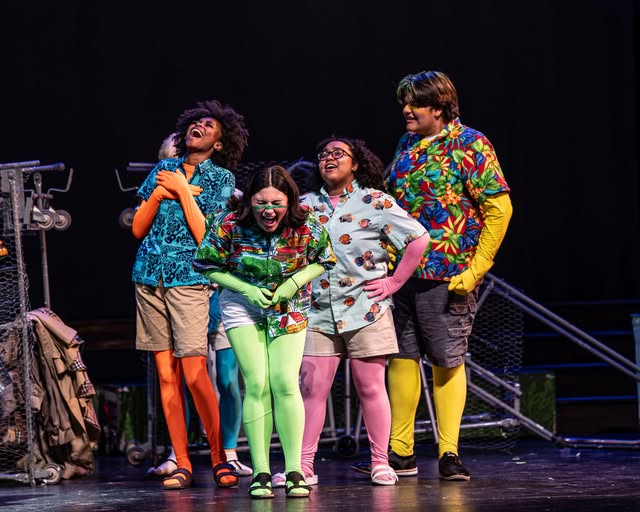
What started as a student-written show quickly evolved into a student-written musical, and after batting ideas around, it became a choose-your-own-adventure musical. Based on the books that were popular in the 1980’s and 90’s. The students took complete ownership, not just of the writing and music, but of the entire production process. They brought in siblings, professionals, recently graduated college students, and volunteers to fill roles like director, stage manager, and designers.
The original vision diverged slightly when we discussed how to move forward. I asked the student writer, “Do you want this to be a fun project for you and your friends, or do you want to bring in people who can help it grow?” They wanted a mix of both. The production relied heavily on volunteers, which was both wonderful and challenging. If they’d had more funding, they might have brought in more professionals, but the volunteer-driven approach gave the project its unique energy.
The Challenge of 32 Paths
My biggest concern initially was managing 32 possible audience-driven paths. As I read through the first version of the script, I realized how complex it would be in production. We’ve done a lot of Disney musicals in our program, which are written like movies with minimal to no space for scene changes. But the students built this well. They thought about how to allow the crew time to transition between paths, allow for costume changes, and create continuity even if it was more challenging in practice than on paper.
They added consistent plot point scenes to give the crew time to change sets, and their voting system (a cheerometer and a narrator) worked just fine. They also structured the show in five blocks, with each block having two options. The first scene of each block was similar, like a field with trees, or a street scene, so the crew had some continuity and time to adapt. This gave them a little breathing room, and it came about even more as we moved into rehearsals and trimmed what was eating up time between transitions.
The Impact of a Compressed Timeline
Could this have worked during the school year? No. It would have had to be a semester-long project because there was so much material for the kids to learn. As it was, they spent four weeks, four to eight hours a day, learning music, blocking, and everything else. Their focus was undivided, which was critical.
As it was, the stress levels were high, especially among the core creative team. The closer we got to opening, the more they overthought their choices and put too much emphasis on perfection rather than the process. My reassurances only went so far. But having it in the summer, and framing it as a fun project, made it possible. I don’t think it would have worked when their focus would have been split between this and their classes.
Unexpected Strengths and Skills
New projects will always turn up unexpected results. New projects, untested projects, will also bring about the truest parts of a personality. How a person responds to pressure, stress, and decision making. Also to criticism and feedback. One of the greatest things I’ve seen from the student writer is their willingness to look at what’s possible. In the past, when they’d come up against a problem, they’d give me all the reasons it couldn’t happen. But in this process, they started asking, “Can we do this? How can we solve this?” instead of listing the obstacles. That shift in mindset was huge.
I also watched several of our crew members, especially the younger ones, step up and embrace responsibility instead of shying away from it. Their problem-solving and leadership skills really shone. It’s what happens when you let students take the lead, and it was exponential compared to a teacher-led project.
That said, conflict resolution was a challenge. The students are very conflict-averse, to the detriment of the project. They see any difference of opinion or feedback as negative, and that’s something we’ll need to work on moving forward.
Where It Fell Short
The biggest area where the project fell short was audience size. We didn’t have the audiences we wanted. From a direction standpoint, we had a very inexperienced director, a college student, who was used to working with more developed actors. More of the work of the show fell on them than they expected, and I don’t think they were fully prepared for that.
There was also a lack of communication between the writers (the creative family at the core) and the director. The creative team made a lot of decisions without involving the director, mostly because they didn’t understand that their input was necessary. They hired them for a reason but didn’t utilize their talents. They also lost their choreographer early on, so the director ended up having to choreograph as well.
I think a clearer delineation of roles from the start would have helped. I was very clear about my role, but I could have, and should have, helped them define their roles more clearly.
Lessons Learned and Moving Forward
Audience Engagement and the Choose-Your-Own-Adventure Format
The choose-your-own-adventure format absolutely created an energy I’ve never experienced in an audience before. The audiences were small but mighty. Sometimes it was awkward, you never know what an audience is going to do when you open the show up to them, but it brought them into the experience in a way that was really special.
What Worked and What Needed Refinement
What worked:
The tech was organized quite well. We allotted more time than we usually give a musical because really, we were teching the content of two musicals and had to rehearse as many combination transitions as possible. We also needed to give the light and sound operators the chance to move through the cues smoothly with as many combinations as possible.
The students sailed through tech surprisingly easily for a show this large. That’s a testament to the dedication of the student teams to the project and to the organizational skill of the student Deck Chief, who I am thrilled to say I get to work with for one more year.
What needed refinement:
Eight-hour days in the summer were tough. I believe a better ballance could have been achieved. The students got tired and frustrated, and sometimes they didn’t advance things as quickly as they could have, or retain information as well.
Communication was the biggest issue. We talked about it, but it came down to communication on the front end. A plan for attendance and absences would have helped a lot. There was an assumption from the creative team that if they needed to pull everyone in for a rehearsal, people would just be there. That wasn’t the case.
Communicating Role clarity would have lessened stress from the start. As mentioned earlier, defining roles more clearly would have prevented a lot of confusion. Adjustments could certainly have been made on the fly, but with a clear delineation from the start, gaps would have been found and addressed sooner, there would have been fewer assumptions made about what was complete, and a lot of bruised feelings could have been avoided.
Reinforcing Beliefs About Student-Led Theater
This project didn’t challenge my belief that students can lead. If anything, it reinforced it. I now have a better understanding of how I can refine my role as a mentor and leader in the process, but I never doubted that kids could take this and run with it fast and hard and far.
Lessons for Future Productions
Communication, communication, communication. I’m a big fan of more tech time than less, but you have to have everything ready and people in place for that to work.
Student buy-in: I’m going to lean heavier on this in my classes this year.
Back to basics: Working on people skills, like conflict resolution and giving/receiving feedback, is something I’ll focus on because the students clearly need it.
Leadership isn’t yelling: The kids know this, and they’ve demonstrated that they can lead by example. But leadership needs to be coupled with clear, forthright communication. Everyone leads differently, and that’s okay, but they need to express their needs and expectations in a way that works for the group. Teaching this in my regular classes is going to be a focus this coming year.
I had a conversation with the student writer about the actors not cleaning up after themselves or following through on tasks. They thought the solution was to yell at them more. She literally said, “We should have yelled at them more.” I told her, “If I stepped in and started yelling at everyone, you’d have a completely demoralized company.” Yelling might work once or twice, but it doesn’t give you the process or the people you want. It might give you the product, but it leaves everyone walking away feeling like they never want to do it again. That’s not what we want. We want people to walk away feeling accomplished and excited to come back.
Final Advice for Teachers Attempting a Project Like This
Communicate early, communicate often. Don’t be afraid to try, but don’t be afraid to put boundaries on your time, especially if you’re doing this over the summer. I set boundaries, there were moments when the kids wanted to come in at 8 a.m., and I said, “I’m not available then. I have other things to do.” (And I did!) But even if I didn’t, taking a couple of hours away from the project is significant and reasonable.
Be clear about:
Your boundaries
Your role
Their roles
Also, have a clear understanding that feedback is part of the process. You have a goal, and you work toward that goal, but the odds are you won’t hit it perfectly. And that’s okay. What defines success? If it’s that everybody learned something, the script advanced, the show advanced, the audience enjoyed themselves, and the actors learned something, then that’s your success. If success is revenue-based or how glossy the project is, I’d reevaluate what you’re doing it for. From an educational standpoint, that might not give you the results in the people that you want.
You can have a very polished product and a very sad, disillusioned group of humans at the end of it. And that’s not what we want, because that’s not what shares the love of the art.
Your Turn
Have you ever led a student-driven project like this? What worked for you, and what would you do differently next time? Share your stories in the comments or over on the Backstage AIC Facebook page. Let’s keep the conversation going, because the best lessons come from the trenches!