What Do High School Theater Programs Actually Look Like?
What Do High School Theater Programs Actually Look Like?
There's a myth about high school theater that it looks one specific way: a drama teacher, an auditorium, a cast list taped to a door, and a spring musical that eats everyone's life for eight weeks. The reality is that "high school theater" is a category, not a blueprint and this week I kept thinking about that, because I found myself looking at two programs that are both healthy, both putting on real work, and structured about as differently as two programs can be.
Neither one is doing it wrong. That's the point. But it's worth looking at how differently the same art form gets built, because program design quietly decides almost everything downstream: the schedule, the shop flow, who builds, who paints, and who shows up.
Two structures, one art form
At the first school, theater is strictly an after-school affair. Productions are extracurricular, everything happens in those few precious hours after the last bell. The drama club runs separately from the productions, functioning something like a Thespian troupe that hasn't formalized yet: kids gathering around the work, building community and identity, but not yet badged into the official troupes and honors structure. The productions are separate, and not every student in the club participates in the shows, which are directed and run by the English teacher. There are no daytime tech classes at all, which means no built-in time for building, painting, or training students in stagecraft. Every hour of work has to be found after school.
At the second school, the shows are on the books as a class. Students earn credit for doing the work, and stagecraft classes exist that can actually build sets. Not everything has to be crammed into a few after-school hours. The work has a home in the school day itself. Rehearsals after school focus on the specific production, acting and technical skills are largely learned during the school day.
Same art form. Radically different rhythms.
The buildings shape the work
The after-school program lives in an older building, and the architecture is the workflow. The shop is in the basement; the stage sits above it. So everything that isn't built directly on stage, every flat, every platform, every piece of a set assembled downstairs, has to be carried up the steps. There's a winch and a trap on stage left that were presumably installed to solve exactly this problem, and they haven't been operational in recent memory.
Interestingly, the theater was just renovated. A much needed lighting and sound upgrade as well as new seats and better auditorium aesthetics. Those are very important, and we’re all loving the LED instruments and improved speakers (not to mention the fact that they remounted the projector so it doesn’t hang in the path of the front of house lighting). The next step, which wasn’t touched in this round of improvements, would be fixing the fly lines, replacing the torn cyc, and making that lift system functional. Years of students carrying scenery up a staircase because the shortcut sits broken, just out of reach.
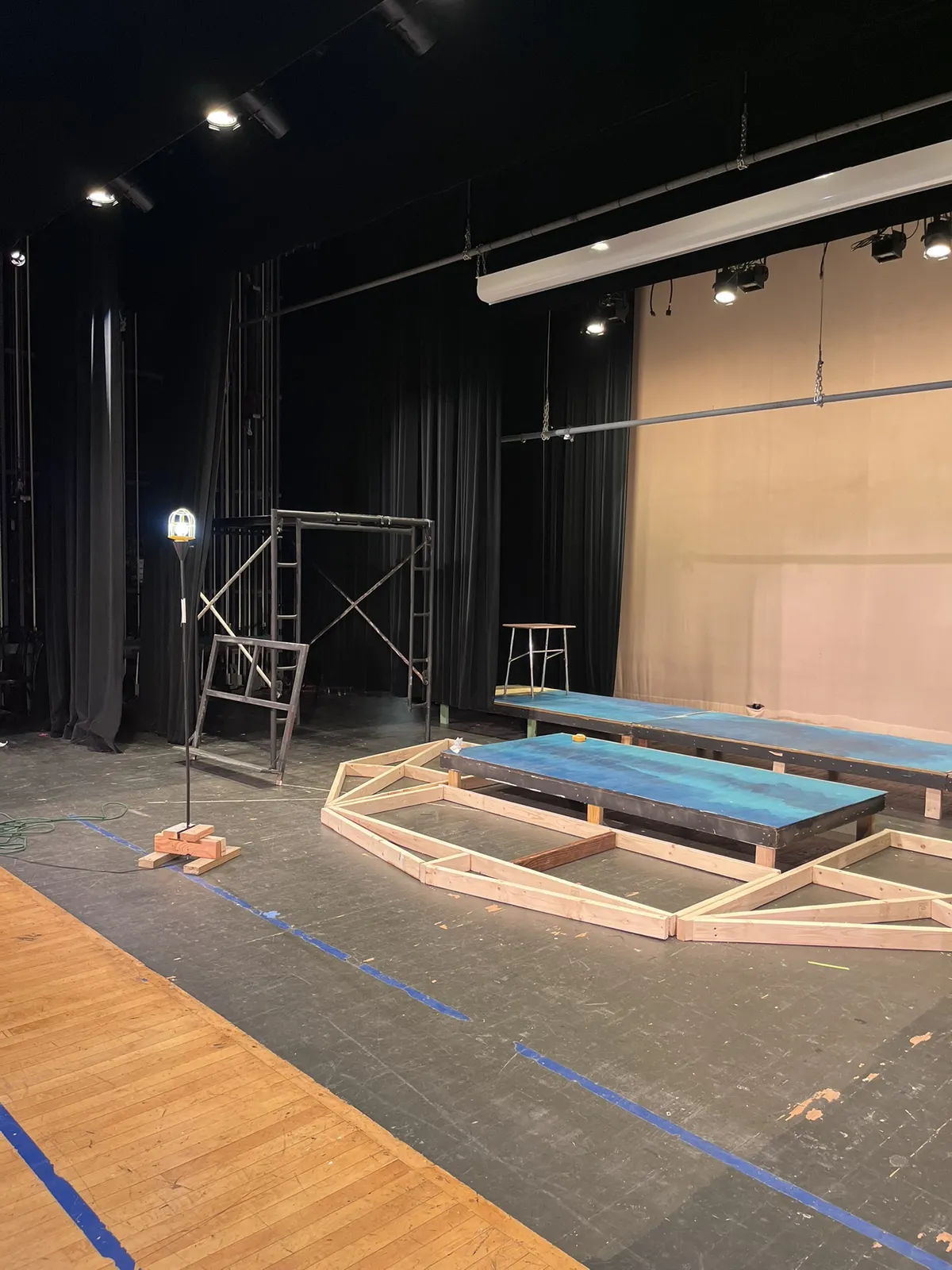
Because build time is scarce and rehearsal time takes precedence on stage, they compete for the same space: building on stage means building around the rehearsal schedule, after 5pm during the week and after 2pm on Saturdays. The set grows in the gaps between blocking and run-throughs.
The second school has the opposite problem, which is its own kind of lesson: the shop can't hold all the scenery. So the workflow is build, move it out, build, move it out, a constant rotation that keeps the shop usable but pushes much of the painting onto the stage. That workflow has gotten more complicated as the daytime classes have grown. More classes means more students, more space needed to accommodate their work, more learners making more mistakes (which is a good thing, but it does slow down progress and eat materials) and a paint-and-assembly process that now has to thread between more student hands.
Both programs have found a flow that works, and both flows are strange enough that nobody would design them this way on purpose.
The budget reality
The after-school program runs on what I'd call a typical high school theater budget: a few thousand for people, a few thousand for the show. The in-school program benefits from dedicated paid staff and a district supported budget. It's assigned money in both cases, not ticket sales or fund raising, but it's worth naming plainly that both programs used to be more substantially funded. Administrations changed. Program leadership changed. The budget is now significantly less than it was at both schools.
It is a fact worth sitting with: "typical" is partly the residue of turnover. What a program has to work with is often less about the art or the people doing the work and more about who happened to be in the room when the numbers get set. The lesson there is; always make sure you are in the room.
The parent volunteer angle
Here's the bonus the older school enjoys: the after-school program gets more regular parent involvement because the work happens after parents' own work hours. They can actually show up. A program constrained to evenings and late afternoons is, almost by accident, a program scheduled around the people most likely to volunteer.
That's worth celebrating, and it complicates the easy story that the "less resourced" program is simply worse off. Structure creates its own gifts.
Neither one is "right"
I keep coming back to this, because it's easy to read a comparison like this as a ranking, the program with classes and stagecraft and a bigger budget is clearly the winner, right? No, both programs are finding creative ways to make shows happen with what they have. Broken winch and all. Build-move-build-move and all.
The real lesson is that program design shapes everything downstream. Whether the show lives in a class or after the last bell; whether the shop is in the basement or beside the stage; whether the budget was set by this administration or the last one, or by the tenacity of the people involved, those decisions, made by people who may no longer be in the building, determine the schedule, the shop flow, who builds, who paints, and who shows up.
All of that, to say this. The art form is the same. The programs are what make it look so different. One isn’t necessarily a better model than the other, because “high school theater” is made up of this, that, and everything in between. Wherever your program sits on the spectrum, it can be the right program. Every director is always working to move toward better. Every program that opens doors for students to feel accomplished and excited is a winning program. And all of them deserve celebration and support.
Where are the programs you support? Come tell us at Backstage AIC’s Facebook Group.